Why the big secret?

There’s a powerful food cartel that doesn’t want you to know where your beef comes from
August 4, 2026
In May of 2017, Brazilian authorities launched Operation Weak Flesh, a crackdown on food safety violations associated with the production and exportation of rotten meat. What they found was shocking, including rampant use of acid and other chemicals to mask the smell of rancid meat. “In some cases, the products used were carcinogenic,” the authorities reported.
JBS was among more than 30 companies caught in the crackdown. Al Almanza was the federal administrator of Food Safety Inspection Service (FSIS) during a 60-day window when this rotten meat was allowed to enter the U.S. Soon after he resigned, he went to work as food safety director for JBS, this time on their actual payroll. JBS would later plead guilty to bribing more than 1,900 politicians in Brazil and agree to pay a $3.2 billion fine. In 2020, the company also admitted to violating the U.S. Foreign Corrupt Practices Act.
Despite these violations, the company managed to stay under the radar. But that’s getting harder to do, now that JBS is the largest meatpacking company in the U.S. In May of 2007, JBS purchased the financially distressed Swift and Company (formerly ConAgra/Monfort) in Greeley, Colorado. JBS wasn’t buying 20% of the U.S. beef slaughter capacity just because it was offered at fire-sale prices. JBS saw it as a valuable gateway into the highest consuming market in the world.
Since then, the company has continued to emerge from the shadows. Late last year, the Batista brothers, who own JBS, donated $5 million to Trump’s extravagant inauguration fund. Before that, in November of 2025, Joesley Batista, a friend of first lady Melania Trump, was welcomed into the White House to help the newly elected administration strategize how to remove Nicolas Maduro as the president of Venezuela, an interaction documented in the new book by New York Times reporters Maggie Haberman and Jonathan Swan, Regime Change: Inside the Imperial Presidency of Donald Trump. Early in 2026, JBS sought and was granted permission for listing on the New York Stock Exchange.
In light of this history, it shouldn’t be surprising that the U.S. beef market is now being flooded with imports from Brazil, generating profits that make the illegal drug trade pale in comparison.
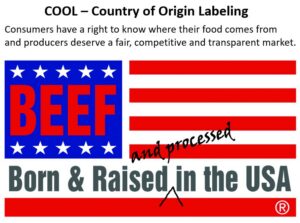
If country-of-origin labeling was mandatory, consumers would know if a cut of beef was from Brazil and could choose to buy U.S. beef instead. Why keep this valuable information secret from the consumer? The simple fact is foreign-owned multinationals like JBS don’t want the consumer to know they are buying food produced by a company convicted of serious food safety violations while bypassing the chance to support U.S. producers.
From 2008 to 2015, grocery stores were required to phase in mandatory labeling on pork, lamb, chicken and goat as a provision of the 2008 Farm Bill. In 2015, Congress reversed the mandate, due to political pressure from the meat industry cartel, including the American Meat Institute and the National Cattlemen’s Beef Association. Speaker of the House John Boehner led the campaign to repeal mandatory country-of-origin labeling, then joined the JBS board after he retired from Congress. Retiring Kansas Senator Pat Roberts carried the bill in the Senate on behalf of the large meatpackers and cattle feeders in his state, earning quiet but resounding applause from JBS and Chinese-owned pork giant Smithfield.
Following the repeal of mandatory labeling, cattle markets crashed. Thousands of ranchers and independent cattle feeders went out of business and consumers at the retail meat case were denied the option of knowing the origin of their beef and pork. As a result, the national cowherd dropped to its lowest level in 70 years, in turn causing retail prices to spike.
Political corruption has fueled the rise of a powerful meat cartel, while importation of unlabeled imported beef continues to destroy the U.S. cattle industry. During July alone, prices for finished live cattle dropped $400 per head, while consumers continued to pay record high prices for beef. Foreign owned meatpackers were able to increase their profit by importing and selling mystery meat. And U.S. ranchers were left to question whether it made sense to rebuild their herds. What happened to putting America first? Is current leadership OK with depending on multinational corporations for our food supply?
Doesn’t the U.S. consumer deserve to know where their beef is coming from? Without mandatory labeling, U.S. consumers are contributing to the wealth of well-connected oligarchs while facing increased risk of foodborne illnesses.
Note: “Product of the USA” labels are not mandatory and do not provide traceability or place of origin for imported products. Consider the benefit of mandatory labeling in the recent lettuce recall.
What you can do now:
The Senate Agriculture Committee is expected to begin marking up the Farm Bill on Thursday. Please call both of your U.S. Senators and urge them to support including mandatory country of origin labeling (MCOOL) for beef in the Senate Farm Bill.
Action: Call your Senators’ offices through the U.S. Capitol Switchboard at 202‑224‑3121 and ask to be connected by name. If you don’t reach a staff member, leaving a voicemail is perfectly fine – your message will still be counted.
Our message should be simple:
“Please vote ‘Yes’ to include mandatory country of origin labeling (MCOOL) for beef in the Senate Farm Bill.”
Independent Beef Association of North Dakota (I-BAND)
PO Box 2
Sterling, ND 58572
www.i-band.org
independent.beef.assoc.nd@gmail.com
Kerry Docktor 701-220-7941
[…] sources. Again, we are not aware of any local purchasing, unless it was beef from Colorado’s JBS or Cargill plants, or lettuce from the Colorado Springs Taylor Farms […]