“Fast Food Nation,” Mystery Meat & Trump’s Dismantling of U.S. Food Safety System: Eric Schlosser
September 17, 2026
 Watch Full Show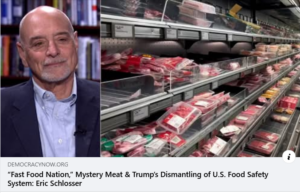
Topics
Guests
- Eric Schlosser investigative journalist and author.
Links
- “Why Did Trump Order Up 660 Million Pounds of Mystery Meat?”
- “Fast Food Nation”
- “The Alligator Alcatraz Boondoggle”
Amid growing concerns over food safety in the United States, President Donald Trump last month authorized the duty-free importation of 660 million pounds of cheap beef trimmings that will get mixed in with other cuts to make ground beef. Imported beef and pork were once labeled with their country of origin, but Congress voted in 2015 to end that requirement, so customers at the grocery store will have no way to identify this “mystery meat,” which is coming mostly from Brazil. President Trump’s proclamation in August came just a day after he met in the White House with Joesley Batista, whose family controls the Brazilian company JBS, the largest beef producer in the world. JBS is notorious for food safety violations and admitted in 2017 to bribing thousands of Brazilian officials for favorable treatment.
“It smells like a pretty corrupt deal,” says investigative journalist Eric Schlosser. He says Trump’s move is “basically screwing over American ranchers,” and the imported beef is “some of the meat most likely to be contaminated.”
Schlosser is author of the landmark book Fast Food Nation, published in 2001. He says that in the 25 years since then, the United States has developed “two food systems.” While affluent and well-educated people increasingly favor sustainable, organic foods and care deeply about how food is grown and consumed, working people and the poor are relegated to the “fast-food industrial system” of cheap, mass-produced food of dubious safety.
Transcript
This is a rush transcript. Copy may not be in its final form.
AMY GOODMAN: This is Democracy Now!, Democracynow.org, the War and Peace Report. I’m Amy Goodman.
NERMEEN SHAIKH: And I’m Nermeen Shaikh. Welcome to our listeners and viewers across the country and around the world.
“If you buy a T-shirt at Gap, it will have a label that tells you where it was made. That’s federal law. The same is true for automobiles, appliances, television sets, every fresh or frozen fruit and vegetable sold at the supermarket. Beef and pork are notable exceptions to these laws. And that may help to explain why President Trump signed a proclamation last month that will allow the duty-free importation of about 660 million pounds of inexpensive beef. If American consumers knew where that beef was coming from, they might not want to eat it.”
Those are the opening lines of a recent article in The New York Times headlined Why Did Trump Order Up 660 Million Pounds of Mystery Meat?.
AMY GOODMAN: The piece is written by investigative journalist and author Eric Schlosser. Twenty-five years ago, he wrote the landmark book Fast Food Nation: The Dark Side of the All-American Meal. The 25th anniversary edition of the book is being published next week. Eric, welcome back to Democracy Now! I remember when we had you on 25 years ago with this groundbreaking book, Fast Food Nation.
ERIC SCHLOSSER: Yeah, I’m so sorry to be here talking about it again. I really wish these problems had been solved and that my book was only of antiquarian interest. But it’s amazing to me to read the headlines and to look at what’s happening right now. The book is about fast food but it’s really about unchecked corporate power. When you want to understand why 660 million pounds of some of the least expensive frozen beef that’s going to go into fast food hamburgers, and why is that coming to the United States? Just remarkable unchecked corporate power.
AMY GOODMAN: Explain what “mystery meat” is, and how did this come into being?
ERIC SCHLOSSER: “Mystery meat” is a colloquial phrase for lean beef trimmings. These are little pieces of frozen beef, the beef that’s most likely to be contaminated, taken from the outside of the animal. It’s sort of generic industrial meat that will then be ground into hamburger meat, mainly for fast food restaurants.
President Trump allowed—made a proclamation saying that 660 million pounds could be coming into the country. It’s quite remarkable that we have this president who talks about “America First” and is so supported by rural America, but with a stroke of his pen is basically screwing over American ranchers. This beef is most likely coming from Brazil.
In my New York Times article, it’s this remarkable coincidence that the day before Trump issued this proclamation, he met with the head of the biggest beef company in the world, JBS. His name is Joesley Batista. He’s one of the co-owners. He met with Joesley Batista at the White House—who, you know, Maggie Haberman at the New York Times said is a friend of Melania’s. I don’t know what that connection is. But he met with Batista and the next day issued this proclamation bringing in hundreds of millions of pounds of beef, most likely from Brazil.
And another really weird coincidence is that the European Union has suspended all imports of beef from Brazil starting the first week of September. And Trump, in allowing these imports into the United States, it just so happens the timing is the first week of September. So it smells like a pretty corrupt deal. The European Union has suspended the import of Brazilian beef for concerns about antibiotic misuse. And this meat is some of the meat most likely to be contaminated.
This company, JBS, I mean, it’s quite remarkable that Joesley Batista was meeting with the president of the United States to help determine our agricultural policy when he has confessed to spending over $186 million bribing almost 2,000 legislators in Brazil, including three presidents of Brazil. I have never met Mr. Batista but he is clearly a very bright man to be able to bribe three presidents of Brazil and yet be meeting with the president of the United States and helping to determine our agricultural policy. I mean, he may have a great career in American politics.
NERMEEN SHAIKH: As you also point out, what makes it even more remarkable is that he was long considered persona non grata in the U.S. And then not long after his meeting with Trump in November at the White House, JBS got approval from the Securities and Exchange Commission to be listed on the New York Stock Exchange.
ERIC SCHLOSSER: The timing is a little different. The largest single donor to Trump’s second inauguration was a subsidiary of JBS. They gave $5 million, which is more than any other politic…any other corporation or individual. And remarkably, not long after that donation, JBS got listed on the New York Stock Exchange, which is something the company had sought for years. But a bipartisan group of American senators, including Senator Marco Rubio at the time, was one of the most vocal critics of JBS. The corruption scandal in Brazil involved JBS bribing Brazilian politicians so that JBS could get loans from a state-controlled bank, and it used money from those loans to buy American meatpacking companies.
NERMEEN SHAIKH: What is the subsidiary of—?
ERIC SCHLOSSER: The subsidiary of JBS that made the donation was Pilgrim’s Pride. But it’s all the same company and it’s owned, controlled by these two brothers. But the real issue here isn’t JBS. It isn’t President Trump. It’s how every sector of the American economy has been taken over by a handful of corporations. Sadly, 25 years ago, I wrote in Fast Food Nation that the great issue—this is a paraphrase—the great issue of the 20th century is basically the challenge to totalitarian systems of power, and the great issue of the 21st century is going to be resistance to unchecked corporate power. So much attention goes to Trump, and what we really need to be looking at are the corporations who are benefiting profoundly from all this deregulation. Whether it’s the oil companies because of the Department of the Interior, the chemical companies because of who runs the EPA, and sadly, the food system now is controlled as never before by a handful of very, very powerful companies. Anyway, I—
NERMEEN SHAIKH: Let’s talk about that, and beef in particular. Four large meatpacking companies control about 85% of the market for beef, whereas in the 1970s, the top four beef companies had only 21%.
ERIC SCHLOSSER: Right. And if you go back to the 1970s—and there were so many terrible things going on in American society, so I’m not being nostalgic for it—but in the 1970s, we had a competitive market for beef, Americans ate more beef then than than they do today, and we had twice as many American ranchers. So the change that has occurred has helped a handful of corporations.
Fast Food Nation paid homage in many ways to Upton Sinclair. Because Upton Sinclair wrote The Jungle in 1906 and he wrote about the meatpacking industry because he thought it was a perfect symbol of the monopoly capitalism of his day. In my book, I paid homage to him by doing the same thing. The whole book is structured to take you to the slaughterhouse. When Upton Sinclair wrote The Jungle, there was something called “the beef trust” and it controlled maybe 55% to 60% of the market for beef. So right now these companies are more powerful than the companies when Upton Sinclair wrote The Jungle.
But Woodrow Wilson broke up the beef trust, and when you talk about the competitive market in the 1970s—things can change for the better. Again, I’m so sorry to be here 25 years later and saying so many of the same things I said 25 years ago. But the reason I do it—things don’t have to be this way. There are certain kinds of problems we’re really going to have difficulty changing, but strict antitrust enforcement, labor unions, food safety laws—these can really have an impact on our food system and on what we eat.
AMY GOODMAN: You note that during the past year, China rejected two shipping containers of beef from Uruguay after finding residue of an anti-parasitic drug in the meat and rejected beef from Argentina reportedly because it tested positive for a band antibiotic that can cause serious blood disorders. Compare that to what’s happening in the United States. There’s this phrase—not just ”MAGA” but ”MAHA,” right? “Make America Healthy Again.” Can you talk about what you call the erosion of food safety regulations under Health Secretary RFK? Robert F. Kennedy Jr.
ERIC SCHLOSSER: Firstly, I’ve been a critic of the American meatpacking industry for 25 years and yet I would rather eat American beef produced in this country than eat Brazilian beef. One of the things that JBS got in trouble for was bribing the food inspectors in Brazil so that contaminated meat could be sold.
AMY GOODMAN: What is “contaminated meat”?
ERIC SCHLOSSER: Contaminated meat is spoiled meat that’s riddled with bacteria. That’s how you get sick. They were using ascorbic acid and other chemicals—this is straight out of Upton Sinclair. So, I’m critical of the American meat system, but if you’re going to eat beef, get American beef and get it ground at your local butcher shop. Back to the—so the FDA is responsible for 80% of the food consumed in the United States. The FDA reports to Bobby Kennedy Jr. That’s all you need to know about is your food safe. I mean, I could spend hours talking about the disgrace of Bobby Kennedy Jr., the unethical qualities of Bobby Kennedy Jr., the routine lies. In the afterword of my book, I write about the infant formula scandal and about the shutdown of one infant formula plant that led to huge shortages of formula a few years ago. You want to talk about monopoly power? There are two companies that control 80% of the market for infant formula.
NERMEEN SHAIKH: Here in the U.S. or globally?
ERIC SCHLOSSER: In the United States. And the federal government buys more than half of the infant formula. So if we wanted to change the infant formula industry, we could do it in weeks, because the taxpayers are paying for it. Anyway, the acting head of the FDA right now has no background in public safety, in public health, has no medical training, has no scientific training. He is an attorney who represented the largest infant formula manufacturer in a case involving potentially contaminated formula.
AMY GOODMAN: This is Kyle Diamantas?
ERIC SCHLOSSER: Yeah. That’s who this administration has put in charge of food safety. The USDA is in charge of the safety of our meat and about a quarter of the USDA employees have been fired.
AMY GOODMAN: He is Donald Trump Jr.’s hunting companion.
ERIC SCHLOSSER: The head of the FDA. Now, look, I want to make one thing clear. These food companies don’t want people to get sick. I’m not saying they’re evil. But they also don’t want to be held liable when they do get sick. And if you’re not testing, you can’t trace; you can’t recall contaminated products. So when you dismantle the food safety system, as is happening right now in the United States, you’re helping these companies avoid legal liability.
NERMEEN SHAIKH: You also just mentioned earlier that despite all the problems with the food industry in the U.S., you would much prefer to have American beef. But can you tell what is American beef and what is not? Because country-of-origin labeling on beef used to be mandatory but it no longer is, and it has been many years since it has not been.
ERIC SCHLOSSER: And it’s amusing, because there’s all this conversation about the free market but if you read Adam Smith, a market only works efficiently if there’s total information. If consumers have adequate information, then the invisible hand is going to lead them to select the right product. When you get rid of that information, the power leads to the corporations. All meat had to be labeled from where it came from until 2015. Then the Republican-controlled Congress got rid of country-of-origin labeling for beef and pork. What’s remarkable is a little more than a year after that, the former speaker of the house, John Bonner, who shepherded this legislation, joined an JBS International board.
When you don’t have country-of-origin labeling, a consumer has no idea where this meat is coming from. And two of the major beef companies are Brazilian-owned now. I’m not being anti-Brazil; If Brazil wants to sell its meat in the United States, put a label on it. Make the best beef there is. I’m actually very libertarian in some ways. If these meatpacking companies want to sell meat full of E. coli and salmonella, put it on the label. Consumers can choose between pathogen-rich meat or meat that has been produced cleanly. And then they can cook it.
AMY GOODMAN: Eric Schlosser, you mentioned Upton Sinclair, who exposed the meatpacking industry and the conditions that the workers worked under. So let’s talk about those workers who feel like they are treated like meat, contaminated meat. I want to go to Jim Pillen. We had this headline a few days ago on Democracy Now! Nebraska’s Republican governor who publicly backs Trump’s ICE raids in Nebraska.
More details have emerged of Pillen’s multimillion-dollar hog business that employs undocumented workers. The New York Times and the Flatwater Free Press report that over the span of more than a decade, Pillen’s company—Pillen Family Farms—has relied on undocumented workers to grow into one of the largest hog producers in the U.S. Despite that, Pillen has often echoed Trump’s racist rhetoric about immigrants and a so-called “invasion.” Talk about the workers in the meatpacking industry.
ERIC SCHLOSSER: I am shocked that he would be employing undocumented immigrants! Here’s the reality, and here’s really why I wrote Fast Food Nation. I wrote Fast Food Nation after I visited the meatpacking towns in the United States. I have been in meatpacking communities in Washington State, Colorado, Nebraska, Texas. My entry to the food system of America was spending a year with migrant farm workers in California, and I wrote about the exploitation and demonization of immigrant workers in California by the governor at the time, Pete Wilson. He wanted to be president and he thought that depicting immigrant workers as welfare cheats was going to be his ticket to the White House.
The reality is—and I wrote Fast Food Nation because I was stunned to find, in the meatpacking plants of the Midwest, the same workers—some of them had worked in strawberry fields in California, now in our industrial workforce. Meatpacking once was a high paid, union job, a higher paid job then an autoworker. So when Upton Sinclair wrote about the exploitation of immigrants, we solved that problem. If you were a meatpacking worker in the 1960s or 1970s, you had a solid middle-class life. Your spouse may not have to work. Your kids could go to college. In a very brief period of time, the meatpacking industry recruited immigrants, many of them undocumented, to serve as strikebreakers because they would be much easier to exploit.
And if there is one message that I have from my work on food, from this book, it’s that we are fed by immigrants. If you look at who’s working in the fields harvesting the fruits and vegetables, who’s working in the meatpacking plants, who’s working on the hog farms, the dairy farms of Vermont, it’s recent immigrants. Huge numbers of undocumented immigrants in the fast food restaurants behind the counter. And the idea that we are demonizing and terrorizing these hard-working people who feed us, it’s an absolute disgrace.
NERMEEN SHAIKH: This book came out 25 years ago. Has anything changed with respect to the consumption of fast food in the U.S. in these last 25 years?
ERIC SCHLOSSER: What has really changed is the eating habits of well-educated, upper-middle-class, and wealthy people. There is such an incredible awareness of food now. I mean, I couldn’t get a publisher for this book in New York City, and the reason I couldn’t get a publisher is that I was told, “Nobody will read a book about food that doesn’t have recipes in it.” It was one of the last independent publishers in Boston that published this book. And now there are—
AMY GOODMAN: How many books have you sold since then?
ERIC SCHLOSSER: I have no idea. I’m very grateful that I’m here with you 25 years later. But there’s now a whole literature on food. There are bookshelves of books on our food system. I’m not taking credit for it; I just am so gratified. So we now have two food systems. We have a food system for the well educated, the wealthy, the upper middle class who are buying sustainable food, organic food, grass-fed beef, watching cooking shows. Then you have a food system for working people and the poor. It’s this food system; It’s the fast food industrial system. And the reason that I am still talking about this is that it’s entirely possible for us to have a food system that provides healthy food for everybody.
One of the things that we don’t talk about are the ways in which the external costs of the industrial food system are imposed on us. Since this book came out, there’s a whole new field of economics called true cost accounting. What’s the real cost of what we’re doing? In the food system, you add up the cost of obesity, food safety, the poverty of food workers, et cetera. One of my goals is to make the real cost of this industrial food appear on the menu.
And, if we are going to give government subsidies, government subsidies shouldn’t be going to soybean and corn farmers in the Midwest to grow animal feed. I mean, 100 million acres are devoted to corn in this country—that’s the size of California—and of that 100 million acres, maybe 350,000 go to the kind of corn that we eat—you know, sweet corn or canned corn. The rest of it is going to—anyway, I don’t want to speak for three hours. But I am hopeful that this system could be changed.
And the one thing I give Bobby Kennedy Jr. credit for—and, you know, a broken clock is right twice a day—is that he had the crazy nerve to talk about the problems with our food system in a way that only a handful of other politicians were willing to do. He did it for very selfish political reasons, but there is an underlying popular opinion to change our food system, and that’s what MAHA has shown.
AMY GOODMAN: Eric, before you go, I want to ask you about the notorious former ICE jail in Florida, in the Everglades. You wrote a piece in The Atlantic headlined The Alligator Alcatraz Boondoggle. Earlier this week, the Department of Homeland Security’s internal watchdog revealed immigrants jailed at Alligator Alcatraz were held in outdoor metal cages that were no bigger than a phone booth. At least 79 immigrants were caged this way, which DHS called “calming areas. They were caged for several minutes up to nearly two hours. Investigators also found Alligator Alcatraz did not comply with standards related to medical care, food quality, personal hygiene, recreation. The jail eventually shut down after legal challenges and scrutiny over its abuse and inhumane conditions. Why did you shift to focus on Alligator Alcatraz, and what should we know about it today?
ERIC SCHLOSSER: My next book is on prisons in America. I’ve been going into prisons in this country since the early 1990s. Unfortunately, President Trump has given me a concluding chapter of the book, which is the outrageous, unconscionable arrest and detention of immigrants in this country who are being completely brutalized. I have gone into maximum security prisons that are terrible and it costs about $50,000, $70,000, $80,000 a year to house someone in a maximum security prison. Maybe $100,000. The immigrants at Alligator Alcatraz had been sent there for civil violations, not criminal violations, and the state of Florida and the American taxpayers were paying a million dollars a year per detainee to be held in the most brutal conditions that you will not find in most maximum-security prisons.
I wrote that article for The Atlantic on Alligator Alcatraz to provide a roadmap for a Democratic Congress to investigate where that money went. I’m an investigative reporter; I could not find out the name of the warden of Alligator Alcatraz. It was being run by a private corporation with no background in corrections. It looks like they were friends of the governor of Florida who were earning a fortune off of exploiting and brutalizing immigrants who were there for a civil—not even—they hadn’t even been convicted of a crime.
So my hope is that we will get a full federal investigation, not only of the human rights violations that occurred at Alligator Alcatraz, but follow the money. Who made a fortune off of this? The only prison that the United States runs that spends more money per detainee is Guantanamo. The idea that we were subjecting busboys, landscapers, people who had been in the United States for decades and committed no crime, to the kind of brutality that we saw at Guantanamo when Guantanamo first opened—it’s a shameful episode in American history and it needs to be fully investigated by Congress.
AMY GOODMAN: Eric Schlosser, congratulations on your work. Investigative journalist, author of several books, including Fast Food Nation: The Dark Side of the All-American Meal. The 25th anniversary edition of the book is being published next week. We will link to all of your recent articles.
Coming up, philosopher Susan Neiman, author of the new book Call it Evil: Understanding the Trump Era. Stay with us.