Behind The Menu: School Lunch Edition
Taking a Closer Look at Who Controls What’s on Our Children’s Lunch Trays
Lauren Tavar Nov 16, 2026
If you’re anything like me, grocery shopping is about more than just putting food on the table. I spend a fair amount of my time reading ingredient labels, looking for the healthiest options, and making intentional choices about what I am feeding my three young boys. Like all of you, I want to give my children the very best foundation.
But as I prepare to send my oldest to our local public school next year, I have started to dig deeper into the food that will be served to my son and many of yours. What I have learned has left me with the firm belief that my children and yours deserve better behind the menu.
We often trust that schools are making those same thoughtful decisions about the food served to our children. But are they?
Who is really deciding what ends up on our children’s lunch trays? Where does that food come from, and how does it get there?
If I asked you those questions, would you know the answers?
Let’s break it down.
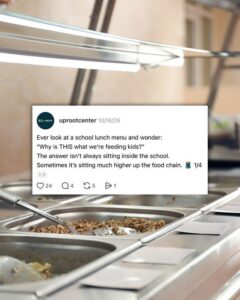
UpRoot on Instagram: “Ever looked at a school lunch and thought…
Who’s Making the Decisions?
So, how does food actually get from the farm to your children’s lunch tray?
Farmers grow raw commodities like corn, wheat and chicken, manufacturers turn some of those ingredients into packaged products, such as chicken nuggets, frozen pizzas, and other processed foods. Distributors then deliver the food to schools, where cafeteria workers prepare and serve the meals to our children.
The process sounds simple enough, but things get a little more complicated when we look at who decides which companies schools purchase their food from.
Those decisions aren’t always made by cafeteria staff. School districts oversee food purchasing, and many hire outside companies to manage their food services.
Three of the major food service management companies are Aramark, Sodexo, and Compass Group, which together control approximately 77.5% of the food service management industry.
These companies can influence which suppliers schools use, and financial incentives can play a role. For example, large food manufacturers often incentivize companies like Aramark to purchase their products by offering rebates or volume discount allowances, essentially money back based on how much food is purchased.
But how does this affect our children’s school lunches?
Depending on purchasing agreements, many school cafeterias must buy from a list of approved suppliers. This is where things get a little more complicated.
Highly processed foods, like chicken nuggets and frozen pizza, can bring in more profit for large food manufacturers than fresh fruits and vegetables. Because of this, manufacturers may be able to offer larger financial incentives, like rebates, to companies that purchase their products.
What does that mean for our children’s lunches?
Imagine a local farmer growing fresh apples just a few miles from a school. Even though those apples are grown nearby, that farmer may struggle to get them onto the school’s menu because they can’t offer the same financial incentives as larger manufacturers.
So, instead of decisions being made solely around what’s best for our children, there’s also money influencing which foods end up on their lunch trays.
Following the Money
This concern goes deeper than local farmers struggling to compete. When large companies are responsible for feeding our children, how can we be sure that their financial interests aren’t taking priority over what’s best for our kids?
In 2010, Sodexo agreed to pay $20 million to settle allegations that it had kept rebates from food manufacturers that should have been passed along to schools and other institutions.
So, why are these large food manufacturers offering financial incentives in the first place? They’re trying to encourage food service management companies to purchase more of their products. When those purchasing decisions influence what’s being served in school cafeterias, these incentives can ultimately affect what ends up on our children’s lunch trays.
This settlement alone does not mean that the food itself is unsafe, but it raises an important concern about transparency and accountability in school food purchasing.
As parents, we pay attention to what we’re feeding our kids. We read ingredient labels, look at where our food comes from, and try to make the best intentional choices for our families. So why should we expect anything different when it comes to the food our children are being served at school?

UpRoot on Instagram: “You go to the farmer’s market. You buy or…
So, What Can We Do About It?
After reading all of this, especially if you’re hearing some of this information for the first time, you might be asking yourself: What does this mean for my children and their school lunches? Is there anything I can do to help make a change?
The good news is, there are ways to get involved.
The first step is understanding how school food purchasing works and who has a say in those decisions. And by reading this, you’ve already taken that first step!
Now that we understand some of the challenges local farmers face when trying to get their food into schools, it’s important to recognize that there have been efforts to make that process easier.
Programs like the Local Food Purchase Assistance (LFPA) and Local Food for Schools (LFS) have helped schools and food banks purchase food directly from local farmers, creating more opportunities for smaller producers.
In fact, 94.5% of funding went directly to local farmers and businesses. In 2023 alone, LFPA distributed $837 million to more than 10,900 independent farmers.
Sadly, in 2025, federal funding for these programs was canceled, creating new challenges for local farmers and the communities they serve.
This information does not mean families are powerless in the process.
Your Voice Matters
Start by asking your child’s school where their food comes from, who their suppliers are, and where they have opportunities to purchase food from local farmers.
Remember, school boards are made up of elected members of your community, and the decisions they make about our children’s food should be just as important as the decisions they make about teachers and curriculum. As parents, we have an opportunity to get involved, ask questions, and hold our school leaders accountable.
We should be able to trust that the same care and intentionality we put into choosing food for our children at the grocery store is being put into the decisions about what ends up on their school lunch trays.
Our children deserve nutritious food, and we deserve to know how those decisions are being made.
Take Action: Sign The Petition
Related: Colorado Voted for Healthy Locally Sourced Food. What happened?