Why Do Economies Need Real Intelligence?
Why Do Economies Need Real Intelligence? Why do real people with human intelligence need to empower and regulate economies?
John Ikerd Jun 1
In a recent interview, Elon Musk said he believes AI (artificial intelligence) will eventually increase productivity so much that work will be optional and money will be useless.[i] He apparently believes that robots will do nearly all jobs better than humans, and nothing will be scarce enough to have monetary value. (Digital transactions might replace banks, but cryptocurrencies are still money.)
Musk didn’t provide any timeline, but credible projections estimate that AI will replace roughly 6% to 15% of the U.S. workforce over the next five years, and could automate 30% of U.S. jobs by 2030.[ii] [iii] In addition, AI is expected to significantly change or “reshape” 50% to 55% of all American jobs.
AI’s primary benefits will be in automating tedious, repetitive tasks, including customer support, using information gleaned by analyzing and condensing vast amounts of data. AI could minimize human error and provide 24/7 operation of automated production systems. The selective use of AI could also simplify and streamline business and public administration functions by providing actionable data insights. This would allow management to focus on strategic oversight, coaching, and organizational leadership.
So how will AI affect the economy? People create economies to meet needs or wants that they can’t meet, or can’t meet as well, for themselves. Economies can span local communities, regions, entire countries, or the world. Transactional economies allow people to meet their needs through impersonal means by working, earning, buying, and selling, rather than personal means of gifting, bartering, or other forms of reciprocity. If societies were willing to return to self-sufficiency, gifting, and barter, there would be no need for money.
Economies also determine how societies utilize or manage their limited or scarce resources, including land/natural resources, labor, and capital, to meet their needs and wants. If the efficiency gains from AI decreased the need for natural resources, labor, and capital enough to make them abundant and free rather than scarce, there would be no need for an economy, work would be optional, and money would be worthless.
Where are the flaws in Musk’s utopian vision of the future, assuming it could actually be achieved? First, economies are created to sustain and enhance the quality of human life on Earth, not simply facilitate economic development or growth. While AI algorithms may be able to replace people as workers or producers, AI cannot replace real people as consumers and members of societies. The needs and preferences of real people evolve as the world changes around them and they reflect on their uniquely human experiences, perceptions, and aspirations for the future. The economy should evolve accordingly. Real people also provide the spark of intuition or insight that ignites transformative economic innovations, such as the steam engine, electricity, the Internet, and AI. Real people must also define the social and political parameters within which the economy must function (laws and regulations) and determine or legitimize measures of economic progress and success (such as employment and the GDP).
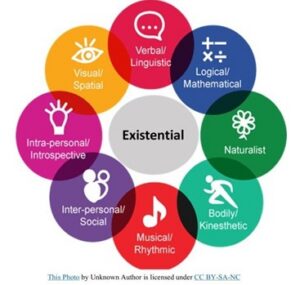
Psychologists have identified nine types of human intelligence.[iv] Artificial intelligence is better at simulating some types than others and is incapable of acquiring some types of intelligence that are critical to determining the quality of human life. AI has exceptional intelligence in logical/mathematical, visual/spatial, and verbal/linguistic intelligence, and is gaining competence in musical/rhythmic, bodily/kinesthetic, and naturalist intelligence. However, AI has no ability to acquire intrapersonal/introspective, interpersonal, or existential intelligence.
Intrapersonal intelligence is the capacity of real people to understand themselves and their thoughts and feelings, and to use their individual knowledge in planning and directing their lives. Intrapersonal intelligence involves not only a person’s appreciation of themself, but also of other individuals with whom they interact in society. Interpersonal intelligence is the ability to understand and interact effectively with others, verbally and nonverbally. It involves not only intrapersonal intelligence but also the ability to distinguish among others, to be sensitive to others’ moods and temperaments, and to appreciate multiple individual perspectives. Existential Intelligence is the sensitivity and capacity to transcend self and others, to engage the deepest questions of human existence, such as the purpose and meaning of life, why we live and die, and what is worth living and dying for.
AI lacks existential and interpersonal intelligence because it lacks intrapersonal or individual intelligence. AI can analyze intrapersonal or individual experiences, to the extent they are recorded as searchable data, and can make predictions about future behavior based on past experiences. However, the experiences that are most important to a person are rarely, if ever, recorded in a searchable database. Some are too personal to share, and others defy expression. They are written in the heart and soul of the real person, and they affect how we think and act. These experiences provide the catalysts for the inspiration, intuition, and insight that motivate individuals to think and act in ways AI cannot understand or anticipate.
AI’s contribution to knowledge is similar to that of statistics, where characteristics of populations are expressed as means or averages and standard deviations, and the likelihood of future outcomes as statistical probabilities. Statistical estimates do not reflect any individual observation, but are characteristics of populations or groups that are unlikely to be present in any single individual or member. AI scans the internet for information related to the subject of inquiry and synthesizes a rhetorical average or consensus response. It uses this same basic process to respond to queries, create documents, and answer questions about financial reports. Individual assessments and opinions are lost in the process of synthesis.
If AI can do most of the work, including management, why do economies need real intelligence? The critical concerns about AI are not so much about how it will affect the nature of work and employment, although these are major concerns that need to be addressed, but who will decide what work AI does and who it works for? Who will determine the purpose of the AI economy, whose interests it will serve, who will grant it power, and establish the bounds within which the economy must function? AI cannot make those decisions because it lacks the intrapersonal, interpersonal, and existential intelligence necessary to make purposeful and meaningful individual and collective decisions. Will those decisions be dictated by the corporate billionaires who now control the development of AI? Or will real people make those decisions individually and collectively through the processes of self-government?
Indications thus far suggest that wealthy individuals and corporations currently developing AI technologies are expected to control the AI-dominated economy. Since the launch of ChatGPT in November 2022, AI-related corporate stocks have accounted for 75% of S&P 500 returns and 80% of earnings growth.[v] Corporate stocks are claims to a share of future corporate earnings, and investors are betting that AI-related for-profit corporations will be the major beneficiaries of AI technologies. These corporations will prioritize private profits over public purpose.
As I have explained in previous “Why? Economics” posts, for-profit corporations are purely economic entities.[vi] They have no capacity to form or express social or moral values. They have no intrapersonal, interpersonal, or existential intelligence. Anything they do for the good of society or humanity is an unintended byproduct of their pursuit of profits and economic growth. If corporate billionaires are allowed to control the future of AI, the economy will be programmed to maximize profits through resource extraction and exploitation and to promote unlimited economic growth through endless technological innovation. People will be misled into believing that AI doesn’t need the Earth’s resources to create unlimited abundance and wealth.
If corporate billionaires are given a free rein to implement AI, they will use the government to serve their economic interests, rather than the common interests of the people. Musk has already proposed that the government should prepare to provide everyone with a “universal high income” so they can buy the things the AI economy will produce. This would eliminate the necessity for corporations to collectively pay their workers enough to buy the products they produce. Musk suggests the government should print money that, once spent, will go directly to AI corporations that are employing few, if any, workers. The money that would have been paid to workers, before AI, ends up as corporate profits.
Also, with for-profit corporations determining the purpose of the AI economy, there would be no incentive to produce so much that everyone had all they needed and wanted without paying anything. In the absence of resource scarcity, there would be no economic value, and thus no way to make a profit. A world where work is optional and money is worthless is nothing more than a utopian vision created to garner public support for unrestrained implementation of AI.
Regardless of how much AI increases productivity, it is highly doubtful that it will do much more than remove some of the drudgery from routine work and perhaps shorten the work week. Similar opportunities to improve the overall quality of life have arisen in the past, but people have always found ways to expand their “wants” faster than economies have grown.
Noted economist, John Maynard Keynes, wrote in the early 1900s, “I draw the conclusion that, assuming no important wars and no important increase in population, the economic problem may be solved, or be at least within sight of solution, within a hundred years. This means that the economic problem is not – if we look into the future – the permanent problem of the human race. Thus for the first time since his creation man will be faced with his real, his permanent problem – how to use his freedom from pressing economic cares, how to occupy the leisure, which science and compound interest will have won for him, to live wisely and agreeably and well.[vii]
Industrial economies grew even faster than Keynes anticipated, and by the mid-1900s, global economic output was more than sufficient to meet the basic human needs of all.[viii] Still, there was abject poverty, hunger, and homelessness, because the wealth had not been distributed to meet even the basic human needs of all. Even in those nations, such as the U.S., where incomes have increased fourfold since the 1950s, the people’s wants have increased faster than their incomes, and poverty, hunger, and homelessness persist. The wants of the wealthy take priority over the needs of the poor. We don’t need AI to solve our economic problems. The economic problem was solved long ago, but we still have not learned to live “wisely, agreeably, and well.”
The worst-case scenario is that once the purpose of maximizing profit and growth permeates the total AI ecosystem, there will be no way to rewrite the history AI’s actions have created and bring it back under the control of real people. Humanity will have to wait until the Earth’s ecosystems collapse to expose the myth of unlimited economic growth on the finite planet Earth. AI may expand the Earth’s potential, but it will not alter this reality. It makes more sense to ensure that the purpose and bounds of the economy remain under the control of real people with real intelligence.
Societies also need real intelligence in families and communities, where individuals gain a shared sense of purpose and values and develop a sense of responsibility to care for others and for the common good of humanity. Societies need workers with real intelligence, not only for innovations that improve the quality of work, but also to challenge corporate cultures that fail to serve the common interests of real people. Armies need soldiers with real intelligence to defend causes that are “just” and to defy orders that are unlawful or inhumane. Human societies have never lived up to their potential as intelligent beings.
Perhaps the challenges of AI will cause us to pause and reflect on what it means to be fully and responsibly intelligent humans. The emergence of AI presents two very different possibilities for the future. One is a technology-dependent world, with wealth and power concentrated in the hands of a few, who use AI to manipulate economies and governments to serve their narrow economic interests. The other is a world that uses AI to address persistent challenges, such as poverty, hunger, and homelessness, to free workers from strenuous, monotonous, and mindless labor, to shorten the time spent working, and expand opportunities for leisure, education, and creativity. Both futures are realistic possibilities.[ix] To realize the potential for abundance that serves human flourishing rather than narrow economic interests, the economy will need to be planned, organized, and controlled by real people who possess real intelligence.
John Ikerd
[ii] https://www.bcg.com/publications/2026/ai-will-reshape-more-jobs-than-it-replaces
[iii] https://www.nu.edu/blog/ai-job-statistics/
[iv] https://www.uthsc.edu/tlc/intelligence-theory.php
[v] https://econofact.org/factbrief/fact-check-have-ai-related-companies-driven-stock-gains-since-the-launch-of-chatgpt
[vi] https://johnikerd.substack.com/p/why-not-treat-corporations-as-real?r=emtwy
[vii] https://www.marxists.org/reference/subject/economics/keynes/1930/our-grandchildren.htm
[viii] https://ourworldindata.org/extreme-poverty-in-brief
[ix] https://scheerpost.com/2026/05/26/the-ai-revolution-where-capitalism-meets-socialism-the-abundance-paradigm-part-2/?utm_source=substack&utm_medium=email
“Why? Economics” questions in the comment section below. Please share on social media and with others who might be interested. For more in-depth explanations of economic issues, see John Ikerd’s books at https://www.amazon.com/stores/John-E.-Ikerd/author/B001JOW2Y8?
Or, check out his websites: https://www.johnikerd.com and https://ikerdj.mufaculty.umsystem.edu/home Like Comment Restack © 2026 John Ikerd
548 Market Street PMB 72296, San Francisco, CA 94104