For a Government to perform even a minimum of service to its people …
The following was posted on X by antitrust attorney, Basel Musharbash:
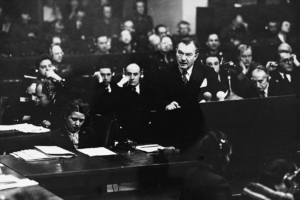
Robert Jackson, Solicitor General of the United States, in Commencement Address at Randolph-Macon College (June 13, 1938).
“I’m reading a 1938 commencement address given by Solicitor General Robert Jackson at Randolph-Macon College, and its advice to college graduates is incredibly on point for our times. Here’s the relevant passage:”
“[T]o perform even a minimum of service to its people,” he said, a Government “must take steps to repress avarice, to strike down privately built up schemes of economic exploitation or oppression, to uproot privilege and to assure social justice and economic opportunity to the masses.
“Whenever such necessities suggest a need for repair of our governmental structure, [however,] we find even men of good will—apart from their interests—dividing in policy[.]
“There will be one group of extremists who will say the house isn’t worth fixing, that it better be burned, or at least torn down to the foundations.
“Then there will be an equally extreme group who insist that not even the leaky roof should be repaired. When it isn’t raining, they will say, ‘You can see that it really isn’t leaking.’ When it rains they will say, ‘You can’t do it economically in such bad weather’ and that the only thing needed is more ‘confidence’ in the old roof and less ‘attitude of hostility’ to it.
“In between, however, stand the great majority of the American people saying, ‘We will bear with moderate imperfections, but we are capable of ordering our own affairs in our own time, and our institutions must advance with the times.’
“The true usefulness to our society of the educated man is not in resisting all change but in anticipating and controlling conditions which will compel change[,] and in guiding the change itself into channels consistent with our American institutions and traditions. He knows that, if events get out of hand, they will ride roughshod over the most humane of theories — and that is what has happened abroad.
“There is an accumulated wisdom of the past which teaches an educated man that excessive economic and social pressures will produce explosions just as certainly as will excessive steam pressures, and that the same forces that furnish motive power to run our democratic institutions, if uncontrolled and overdone, may well shatter them.
“Do you [graduates] think that today in our American life[,] social and economic pressures upon large portions of our population are approaching the unbearable point? You who are looking out at the world in quest of a chance to make a living in it can answer that question as well as I. If the more fortunate 11% of our youth who have college opportunities find their hopes low and their ambitions frustrated, what must the pressure be on the others—especially on the disadvantaged 11% of youth at the low end of opportunity’s scale? And, if you find that these pressures are reaching danger points—that, then, is a challenge to the educated man of today.”\
For more on the speech: https://thejacksonlist.com/wp-content/uploads/2014/06/20140613-Jackson-List-Randolph-Macon.pdf
Additional excerpt:
“Perhaps there is no more severe test of a people’s
capacity for upkeep and improvement of their whole culture
than the way in which they deal with the most powerful and
inclusive organization of their culture—their government.
That institution not only reveals the level of thought and
spirit of a people, but reacts upon, and with great force
influences, the civilization of which it is a product. Where
people neglect it, we find corruption; where the people
forsake its leadership, we find weakness and division; where
they use it in passion or fear, we find oppression. Only
where the people are diligent to support a strong but
reasonable and tolerant government [do] we find social peace
and orderly and happy lives. Strong governments always
respect liberties. It is only weak and fear-ridden
governments or officials who try to deny freedom to their
critics or to their adversaries. Arrogance, whether of
officialdom or of wealth, is always the unconscious
confession of fear.”