JBS plant closure upends Lancaster County cattleman’s plans
Darwin Nissley and other Eastern producers are bracing for higher trucking costs and tighter margins as JBS exits Pennsylvania.
Chris Torres, Editor,American Agriculturist
June 23, 2026
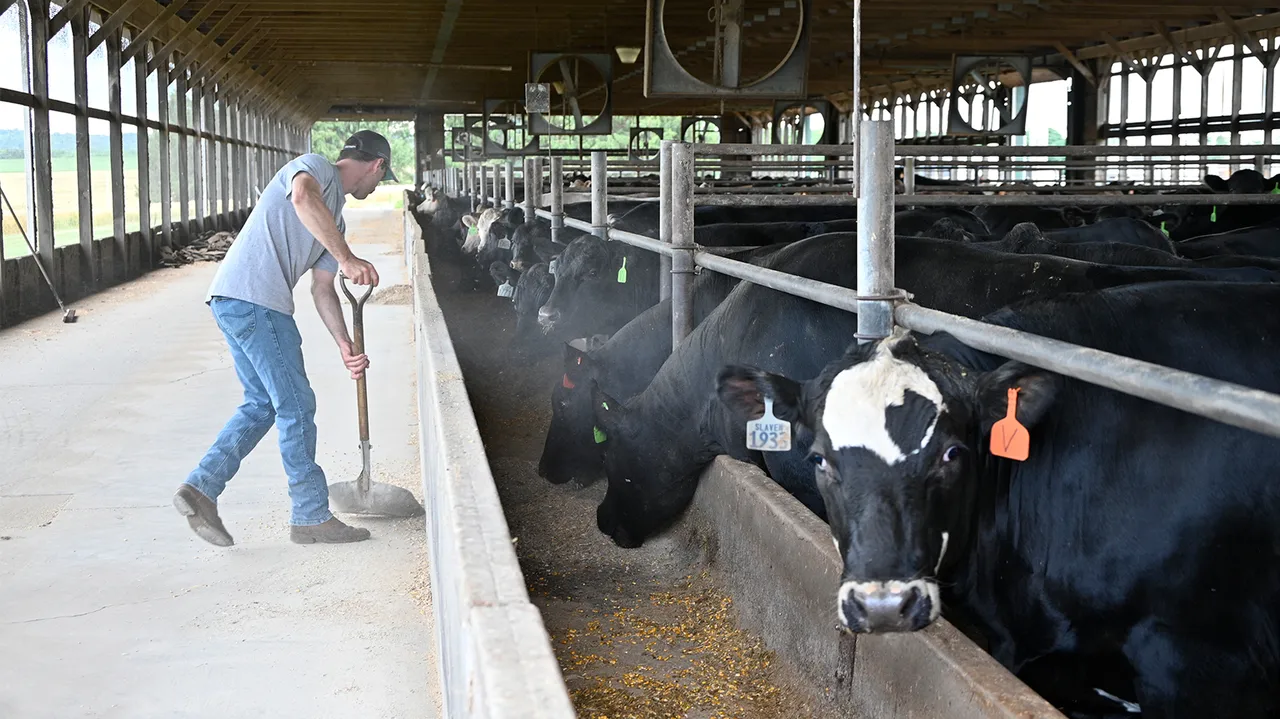
A worker feeds a group of feeder cattle at Nissley Brothers Farm in Mount Joy, Pa. The farm is directly affected by JBS’ decision to close its Souderton, Pa., processing plant.Chris Torres
Even though he is 68 years old, Darwin Nissley had no plans to stop feeding cattle on his Lancaster County, Pa., farm. Then came the news that JBS was closing its Souderton, Pa., plant on Aug. 14.
For Nissley, the plant’s closure changes everything on his farm.
“It’s a disappointment. Didn’t want to retire yet. Makes you look at things a little different,” he said.
JBS is closing the plant, and a value-added facility in Memphis, Tenn., amid a challenging time for beef packers, as cattle numbers continue falling and prices remain high.
The plant dates to 1974 and was originally owned by the Moyer family, who began producing meat products in 1877. It became part of Smithfield Foods in 2001 and became part of JBS when the company acquired Smithfield’s beef operations.
Nikki Richardson, spokesperson for JBS, said the plant’s capacity was about 2,000 head a day, but it was not operating at capacity. About 20% of cattle were sourced from Pennsylvania; the remainder came from neighboring states and Canada, and as far away as Iowa.
Richardson said the company would continue buying cattle from Pennsylvania and neighboring states.
“We will continue purchasing cattle from Pennsylvania and the East Coast region; they will be going to other JBS beef production facilities like Plainwell, Mich., and Green Bay, Wis., for example,” she said.
Higher costs, less profits
Even so, beef producers — especially farther east — are bracing for higher trucking costs, which will cut into margins. Bill Devore, president of the executive committee of Pennsylvania Cattlemen’s Association, said the closure will probably lead to a 10- to 15-cent-per-cwt reduction in fed cattle prices to account for higher trucking costs.
He said there’s been talk of other companies moving into the plant, but the challenge is that it’s antiquated and might be a hard sell. He said JBS would maintain a buying station it operates out of leased space in Denver, Pa., as well as another buying station in the western part of the state.
Still, losing the plant’s slaughter capacity will hurt.
“This is going to hurt us,” Devore said. “JBS pulling out of Pennsylvania, Cargill and Nicholas can’t replace taking a 1,600 head a day out of the East. I don’t care if you can truck everything. It’s going to hurt.”
Nissley, who’s in partnership with his brother and runs an 800-head feedlot in Mount Joy, Pa., sold fed cattle directly to JBS. He visited the Souderton plant two years ago and was assured by plant officials that there were no plans to close it.
He’s concerned about the increased cost he will likely have to absorb to get his cattle to slaughter.
“I did some math, and if the cattle go to Michigan, according to my calculation, that will be $75 more per head, which is my profit. That’s more than my profit,” Nissley said. “We always try and figure to get $50 per head of profit over all our costs and expenses. That’s feed costs, market value for the feed and yardage to cover our fixed costs. If you figure all that in, it doesn’t leave you a whole lot, and then the extra trucking, this market isn’t going to be like it was the last two or three years forever.”
Nissley said his nephew was in line to take over the feedlot. Now, he’s concerned about the impact it will have on the farm’s future.
“Someone like him, that’s in his mid-20s, that changes a lot for him because he won’t have the opportunities that we had when we were younger,” he said. “The farmer will take the hit; JBS won’t. We don’t have chickens, we don’t have hogs, we feed cattle.”
JBS is the world’s largest meatpacker. The company is closing its Souderton, Pa., plant in August, leaving East Coast beef producers with one less place for their animals. (Chet Strange/Getty Images)
More plant closures?
The Souderton plant’s closing won’t do much to solve what’s been an ongoing problem in the beef industry: a lot of processing capacity but not enough cattle being brought in.
“It’s been extremely tough for the packers. There’s just been a lack of cattle for the last two to three years,” said Derrell Peel, professor of agricultural economics at Oklahoma State University. “Given the challenges we face, it’s not a surprise that we continue to see some adjustments.”
At 2,000 head a day, Peel said the Souderton plant is small compared to much larger plants in the Midwest and Plains that can slaughter up to 7,000 head per day. “We could probably lose one more big plant some place, and that might bring things back into balance. But who knows?” he said.
Cattle slaughter continues its multiyear downward trend. Peel said this year is on track to have a national beef cow culling rate of just over 7%, a record low. At the same time, heifer retention, an indicator of herd rebuilding, is lagging.
January’s national inventory of heifer retention showed a nine-tenths of 1% increase in replacement heifer inventory in 2025, not enough to indicate herd expansion.
Peel thinks it will take several years before herd rebuilding shows up in processing plants. Until then, more plant closures could be coming.
“Once we start with heifer calves, the biology of cattle production takes over,” he said. “So, if we save a heifer calf in 2026, breed it in 2027, it calves in 2028. By the time the calf is weaned and through the feedlot, now you’re past the end of the decade.”
Unanswered questions, uncertain future
Nissley said he has a lot of decisions to make before the plant closes in August. If he’s going to exit the cattle business, he doesn’t want to up the feed he normally does for his cattle, he said.
He’s hoping the company will offer fair prices to him and other producers, and won’t abandon the area.
“If they don’t want them, I guess we’re going to have the world’s biggest BBQ out here,” he said with a laugh.
What will Nissley do and when will he decide? He said one thing is certain: “One thing is for sure in the cattle business, nothing ever stays the same.”
Read more about:
About the Author
Editor, American Agriculturist
Chris Torres, editor of American Agriculturist, previously worked at Lancaster Farming, where he started in 2006 as a staff writer and later became regional editor. Torres is a seven-time winner of the