The Values of Work
Some values can be priced; others are priceless.
Work is love made visible.
By John Ikerd
OCT 7
People work to make money! The money paid in wages and salaries is the value of work, right? That’s one value, but not the only value. Some people work because they have to, and hate it. Others work because they like to, and love it. Some people choose to work even when they don’t get paid to. The value of work can’t be reduced to dollars and cents.
Work obviously has economic value, at least some work. Economists treat land (nature), labor, and capital as the three basic factors of production, or the sources of economic value. Labor and capital are used to transform nature’s resources into things that have economic value. Some early economists attributed all economic value to labor. They argued that capital is acquired by underpaying or exploiting labor, making labor the sole source of new economic value.
Regardless, wages and salaries reflect labor’s direct contribution to economic value. In the U.S., wages and salaries account for more than 40% of the total economic value of goods and services, as measured by the Gross Domestic Product (GDP). Including fringe benefits, such as Social Security, Medicare, retirement, and pensions, total worker compensation accounts for more than 50% of total production costs. Even if labor is not the sole source of economic value, workers are major contributors to the U.S. economy.
From the workers’ perspective, wages and salaries account for about 50% of consumers’ disposable incomes. Payments linked to current and previous employment, such as employer-paid insurance and pensions, account for around 10% of disposable income. The rest comes from government transfer payments, investment income, such as interest, dividends, and rent, and profits from individually owned businesses. Most people can’t live on income from investments, rents, and profits. The economic value of work is critical to the well-being of workers.

However, work also has non-economic values. When people not only work well together but enjoy working together, work has social as well as economic value. Social value depends on the quality of personal relationships, not the efficiency of professional relationships. When personal and professional relationships conflict, both suffer. So, workers are often discouraged from forming personal relationships with coworkers or colleagues. However, personal relationships are more resilient than professional relationships. Personal relationships are reciprocal and forgiving, rather than transactional and demanding. They are cooperative rather than competitive. Succeeding together is more important than who gets credit.
Best friends are often formed among coworkers. “Friends for life” are often people who once worked together and have stayed connected. Many people learn to get along with people who are different from them and to bond with people like them on their first job. Working relationships provide an opportunity to learn what it means to be part of a community and society. These values of work can’t be measured in dollars and cents.
Thanks for reading Values Economics! Subscribe for free to receive new posts and support my work.
Work also has moral or spiritual value. If people are asked to introduce themselves, or to think about who they are, they are most likely to respond or think of themselves as what they do—their work. They may say “I work for ________, or I’m a stay at home mom, or dad”—doing the important work of raising the next generation. Or, “I am a farmer, factory worker, teacher, lawyer, doctor, nurse, first responder, homemaker, secretary, retired…“ Even when it feels like a burden, our work often provides the means for us to do the other things we feel we were meant to do with our lives.
In the words of Kahlil Gibran, a Lebanese-American writer and poet:
“Always you have been told that work is a curse and labour a misfortune.
But I say to you that when you work you fulfill a part of earth’s furthest dream, assigned to you when that dream was born,
And in keeping yourself with labour you are in truth loving life,
And to love life through labour is to be intimate with life’s inmost secret.”
He seems to be saying that when you work, you fulfill part of your purpose for being. Our purpose is not limited to working for money or to doing anything that we might call work, but when we work, we should understand that our work has purpose. Gibran suggests that working with purpose is an expression of love of life, or a belief in the inherent goodness of life. “And when you work with love you bind yourself to yourself, and to one another, and to God.”
“Work is love made visible. And if you cannot work with love but only with distaste, it is better that you should leave your work and sit at the gate of the temple and take alms of those who work with joy.”
Gibran goes on to suggest that all work is of equal inherent worth; that no one’s work or purpose is more important or valuable than anyone else’s.
“Often have I heard you say, as if speaking in sleep, ‘He who works in marble, and finds the shape of his own soul in the stone, is nobler than he who ploughs the soil.
And he who seizes the rainbow to lay it on a cloth in the likeness of man, is more than he who makes the sandals for our feet.’ But I say, not in sleep, but in the over-wakefulness of noontide, that the wind speaks not more sweetly to the giant oaks than to the least of all the blades of grass.”
Dr. Martin Luther King, Jr. also affirmed the equal worth of all work:
“If a man is called to be a street sweeper, he should sweep streets even as a Michelangelo painted, or Beethoven composed music or Shakespeare wrote poetry. He should sweep streets so well that all the hosts of heaven and earth will pause to say, ‘Here lived a great street sweeper who did his job well.’”
All of this seems pretty philosophical until you think about how people actually live their lives. Why do young people with the intellect and educational opportunity to start working at six-figure salaries take low-paying jobs as teachers, social workers, or with social justice and environmental nonprofit organizations? Why do artists, actors, musicians, poets, and writers continue creating and performing long after it becomes clear they will never earn more than just enough to get by—if they are fortunate enough to do even that? And why do so many people continue working after they retire, doing things for others with no expectation or desire for payment? These people must make a living somehow, but their career choice is not based on the economic value of work.
Admittedly, some people choose occupations where they expect to make the most money. Some stick with those jobs; some because they want to and others because they choose a lifestyle that makes them feel they have to. Others choose occupations they expect to bring them the greatest satisfaction; perhaps because they think they will like the work and the people they will work with, because they feel it is the kind of work they are meant to do, or both. If they can meet their basic economic needs while living the life they want, working with people they like who share their values, doing the work they feel they were meant to do, they know they have all of the money they need.
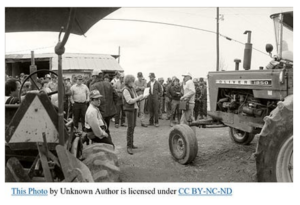
During the farm financial crisis of the 1980s, I was Head of the Agricultural Economics Extension Department at the University of Georgia. An important part of our responsibility was working with farmers at risk of losing their farms through bankruptcy and foreclosure, many through no fault of their own. Farmers had been misled into taking out large loans at record-high interest rates based on expectations of strong export markets that failed to materialize. Regardless, many farmers lost farms their families had owned for several generations. Depression and divorces were epidemic in rural areas, and farmer suicides were not uncommon—several occurring in Georgia.
As an economist, I couldn’t understand why losing the family farm would cause a farm couple to divorce or a farmer to commit suicide. I saw the farm as a business—a way to make money. I could understand that losing the farm income would place stress on the family, but I thought farm families would be strong enough to endure it. They could find another way to make a living, and perhaps have a better life elsewhere in a different occupation. I certainly couldn’t see why losing the farm business was a reason to commit suicide.
At that time, I didn’t understand the non-economic values of work. I didn’t understand that when farm families lost their farms, they lost their friends, their neighbors, their communities, and their sense of belonging and meaning. I didn’t understand how personal relationships among family members were interconnected with their farm. When they lost the farm, they became a different family, and in some cases, a family that no longer had a purpose for being together.
I obviously don’t know for sure what motivated those people. However, when a farmer, usually a man, lost a farm that had been in his family for several generations, he may well have felt that he had betrayed a sacred trust. He was the caretaker of the family heritage, and he had lost it. I have known many farmers who feel that farming is their purpose in life, their reason for living. Some farmers who lost a farm during the 1980s may have seen only its economic value, declared bankruptcy, and started over again in another occupation. I suspect those who became depressed or committed suicide felt they had lost far more than the economic value of the farm; they had lost their purpose for living.
This same kind of thing happened when workers in the U.S. lost their good-paying jobs as factories moved out of traditional industrial areas to exploit low-paid, non-union workers elsewhere and again when U.S. factory workers were displaced by economic globalization. Economists and politicians expressed concern about the economic value of work but largely ignored the social and moral values. The economic displacement of workers destroys not only people’s livelihoods but also their way of life and their life’s purpose—the social and moral values of work.

Economists and politicians once again seem completely unprepared for, or perhaps unconcerned about, the non-economic costs that artificial intelligence, or AI, will impose on workers. The experts disagree about many of the consequences of AI, but there is general agreement that AI will displace at least as many workers as globalization, and perhaps as many as were displaced during the Industrial Revolution.
When the so-called experts talk about the costs of job losses due to AI, their discussion is almost always about the economic implications of worker displacement and reemployment. What about the loss of friendships, the sense of belonging and self-worth, and the lost sense of purpose and meaning in life? When are economists and politicians going to wake up to the fact that work has values beyond economics?
John Ikerd
Thanks for reading Values Economics! Subscribe for free to receive new posts and support my work.
https://www.reuters.com/business/us-workers-share-gdp-skids-fresh-record-low-2026-08-06/
https://www.congress.gov/crs-product/IF10501
https://fred.stlouisfed.org/series/DPCERE1Q156NBEA
https://www.poetry.com/poem/54030/on-work
Add your insights or ask questions in the comment section below. Please share on social media and with others who might be interested.
For more in-depth explanations of economic issues, see John Ikerd’s books at https://www.amazon.com/stores/John-E.-Ikerd/author/B001JOW2Y8? Or, check out his websites: https://www.johnikerd.com and https://ikerdj.mufaculty.umsystem.edu/home
© 2026 John Ikerd
548 Market Street PMB 72296, San Francisco, CA 94104
Unsubscribe